



Just because a manager was successful in a previous role does not mean they will automatically succeed in your company. Different companies, cultures, and teams require different approaches. A manager who thrives in one organization may still fail in another. Companies, society, and people’s attitudes toward work are changing. When selecting managers, it is essential to understand what they build on, what techniques they have at their disposal, their managerial style, and whether they are the right fit for your organization. Read more about how to effectively map the potential of future leaders in this article published on HR News by Barbora Daňková, HR Science Manager at TCC online.
How the Combination of Decision-Making and Managerial Styles Creates 16 Unique Managerial Styles
Different work environments and team goals call for different leadership approaches. What works perfectly in a traditional, process-oriented company where people have clearly defined tasks could quickly discourage talented people in an innovative startup. That is why it is important to map how a specific manager operates and how they lead their team toward results.
The Managerial Style questionnaire focuses on two main areas of managers’ responsibilities: decision making and goal achievement.
4 Basic Managerial Styles in Decision Making
A manager may focus primarily on performance itself and maximizing it, even at the expense of people—or they may primarily take their team, its needs, and long-term satisfaction into account, even at the expense of results. They may also make decisions entirely on their own, or involve their people in the decision-making process and work with opinions and solutions that come from the team.
Based on their approach to decision making, we distinguish four basic managerial styles:
- pacesetting,
- mentoring,
- relational,
- and coaching.
4 Basic Managerial Styles in Achieving Goals
In the area of achieving goals, a manager may lead their people through clearly and specifically defined tasks, where everyone knows exactly what they need to do, how to do it, and by when. Alternatively, they may focus more on broader objectives, the vision of what the result should look like, and what purpose it should serve, while giving their people greater freedom and relying on their expertise. At the same time, the manager may place greater emphasis on control and personal supervision, or give people more autonomy, including room for mistakes, while focusing more on motivating them to engage.
This creates four managerial styles in the area of achieving goals:
- leader,
- puller,
- perfectionist,
- and maximalist.
By combining both areas, 16 unique leadership styles emerge. Each has its advantages but also potential risks, especially if its application does not align with the team’s, company’s, or subordinates’ needs and focus. Each of these styles can be highly effective and lead to outstanding results, but it can also be completely ineffective and inefficient.
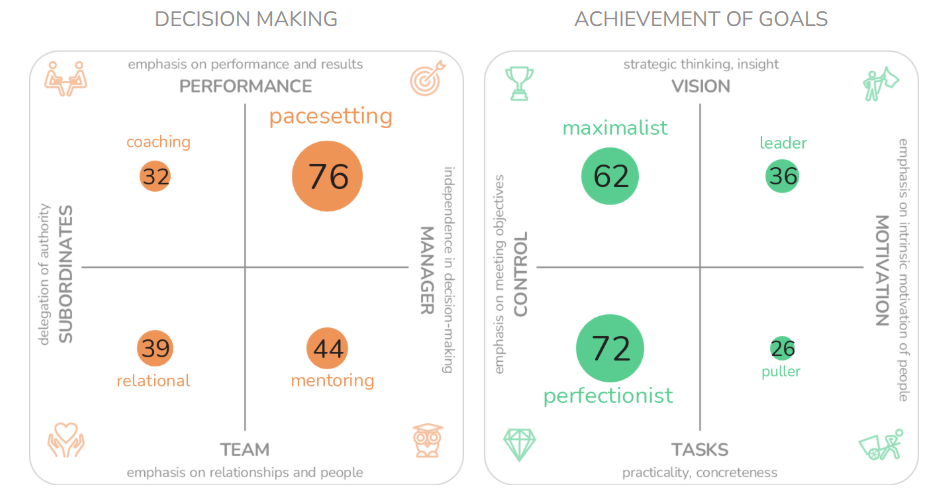
Sample from the output report of the Managerial Style questionnaire
Situational Leadership
The Managerial Style questionnaire focuses not only on mapping and naming preferred managerial styles but also offers insight and practical tips regarding the composition of the team the manager leads. The method takes into account the seniority of subordinates in terms of knowledge, skills, and abilities. It therefore distinguishes between teams that consist mainly of juniors and those that consist mainly of experienced experts. It also monitors their approach to work and engagement. It assesses whether they are active, motivated, and high-performing individuals, or whether they need encouragement to perform and achieve weaker results without greater support.

Situational leadership – sample from the output report of the Managerial Style questionnaire
The chapter of the output report on situational leadership aligns preferred managerial styles with different types of subordinates and provides managers with specific recommendations on which areas to prioritize in their development.
Let us take the example of a manager who prefers the pacesetting perfectionist style, based on defining standards and consistent control. If this manager leads a team of experienced experts, they are encouraged to give them more room for involvement and create opportunities for self-realization. This allows the manager to make better use of their potential. If they were to “manage them on a short leash,” they could weaken their enthusiasm and motivation.
What Are the Benefits of Mapping Managerial Style?
The Managerial Style questionnaire helps managers and HR professionals better define a preferred leadership approach, including its strengths and potential bottlenecks. It also provides practical recommendations on how to better align the applied leadership style with a specific team, or what to prioritize in further development.
Diagnostics reveal the causes of more complex problems within a company. One example is a company struggling with low motivation, lack of independence, and a rather passive approach among employees. At the same time, management expected a much higher level of engagement from people. It was also a company with very ambitious plans and a historically performance-oriented culture. Mapping the prevailing managerial styles showed that the greatest barrier to team proactivity and creativity was relentless pressure for results and high expectations. Rather than focusing on how to succeed, people were focused on not failing or drawing criticism.
Examples of How to Use the Managerial Style Questionnaire
External Recruitment and Hiring Processes
When filling key managerial positions, you need to know whether the candidate’s style is aligned with the company culture and the needs of the team.
Example: You are looking for a manager for a team of senior experts. The questionnaire reveals whether the candidate has the prerequisites for a delegating style or whether they tend toward micromanagement, which would demotivate experts.
Internal Promotion and Talent Management
The transition from an expert role to a leadership role is a critical moment. Not every excellent specialist is naturally suited to management.
Example: Are you considering promoting a senior programmer to team leader? The questionnaire shows how their personality profile is reflected in managerial activities and where they will need the greatest support. You will also identify areas where rapid development can be expected, and where investment in training would probably be less effective.
Mapping Managerial Potential Across the Company
During reorganizations or strategic changes, leadership needs to know what kind of “management capital” is available.
Example: A company is transitioning to agile management. Diagnostics make it possible to map managerial style preferences across the entire organization and determine who is ready for the change and who will need intensive coaching.
Linking Managerial Style with Personality Prerequisites
In managerial practice, self-reflection is extremely important. It is about whether managers truly know themselves, including their limitations. Knowing which activities and situations require them to motivate themselves more – and where they need to slow down – often determines their success more than ability or skill. Good self-awareness is also the starting point for further development and self-improvement.
The outputs of the Managerial Style questionnaire can be linked with the outputs of the Multifactor Personality Profile. By linking them, you can find out not only the preference for individual managerial styles, but also the extent to which they stem from personality settings and the extent to which they are a conscious choice, for example based on experience. If a managerial style differs significantly from the personality profile, this may indicate where the manager is operating outside their comfort zone in the long term, and therefore what is likely to cost them the most energy.
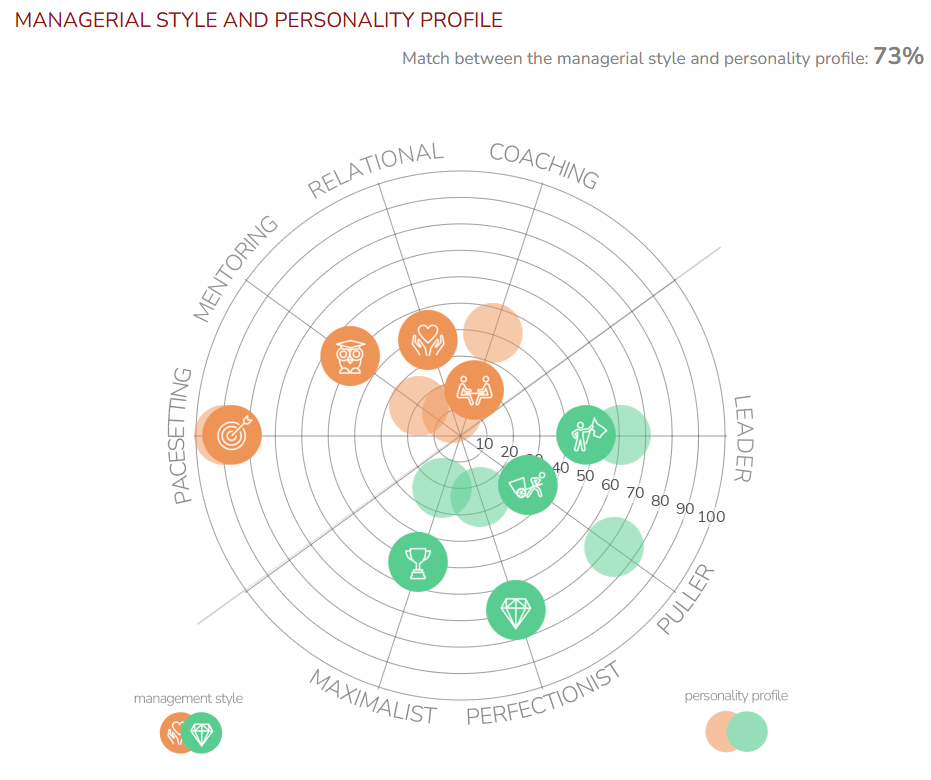
Alignment of managerial and personality profiles in the output report of the Managerial Style questionnaire
Trust, But Verify
When selecting candidates for managerial positions, bear in mind that candidates will prepare well for the hiring process and will most likely gather as much information about the company as possible. They are usually bright people who are used to dealing with complex situations, so it is possible that they have a fairly good idea of what kind of managers you are looking for.
So how can you tell whether a candidate is merely styling their answers to fit the expected role, or whether they really are the way they describe themselves? The questionnaire takes this into account as well. It includes a control scale focused specifically on self-presentation. When there is a risk that a candidate is portraying themselves in a disproportionately positive light, the questionnaire alerts you and reveals how much distortion may have occurred.
For more information about using psychodiagnostic methods to hire and develop managers, contact us at info@tcconline.eu or explore our Psychodiagnostics packages for managers.