


When it comes to effectively targeting development and training, we need to know not just what to develop, but also how to do it. Read this article by Marta Fabiánová, recently published in Firemní vzdělávání, and discover how the synergy between psychodiagnostics and 360° feedback creates a development roadmap that respects individuality and delivers measurable results—without investing blindly.
The same development goal can look completely different for everyone. One person might thrive by reading an inspiring book, while another needs regular mentoring sessions. In practice, combining psychodiagnostics with 360° feedback has proven highly effective in identifying both individual and team development needs.
Psychodiagnostics: Deep Insights into Individuals and Teams
Psychodiagnostics maps each individual’s unique potential and compares their traits against the general population. It translates subjective impressions—like “I’m reasonably assertive”—into hard data, which might reveal that the person is actually more assertive than 95% of the population.
These results highlight a person’s greatest potential for growth. At the same time, they identify blind spots—which are often just the flip side of those very strengths—and highlight areas ripe for development.
Psychodiagnostics can also be tailored to a specific role. By using a predefined benchmark—such as TCC online’s Job Matching, which measures how well a person’s traits align with a position’s requirements—we can pinpoint which traits are critical for success in that role.
For instance, if someone’s overall profile fits a role perfectly except for their score on autonomy, their development goal can be specifically targeted toward building independent decision-making skills.
High-quality psychodiagnostics also provides deep insights into team, department, or company-wide dynamics. Through team reports, it can identify shared development themes. If a team is packed with creative, relationship-oriented people but lacks pragmatic finishers, development can focus on the specific routines, skills, and tools needed to channel that creative energy and add structure.
A team report also shows managers exactly where their personality aligns with their team and where it clashes. Take a visionary manager focused on opportunities, leading a team of detail-oriented risk-assessors. To succeed, this leader must learn to translate big ideas into clear, structured, and actionable tasks.
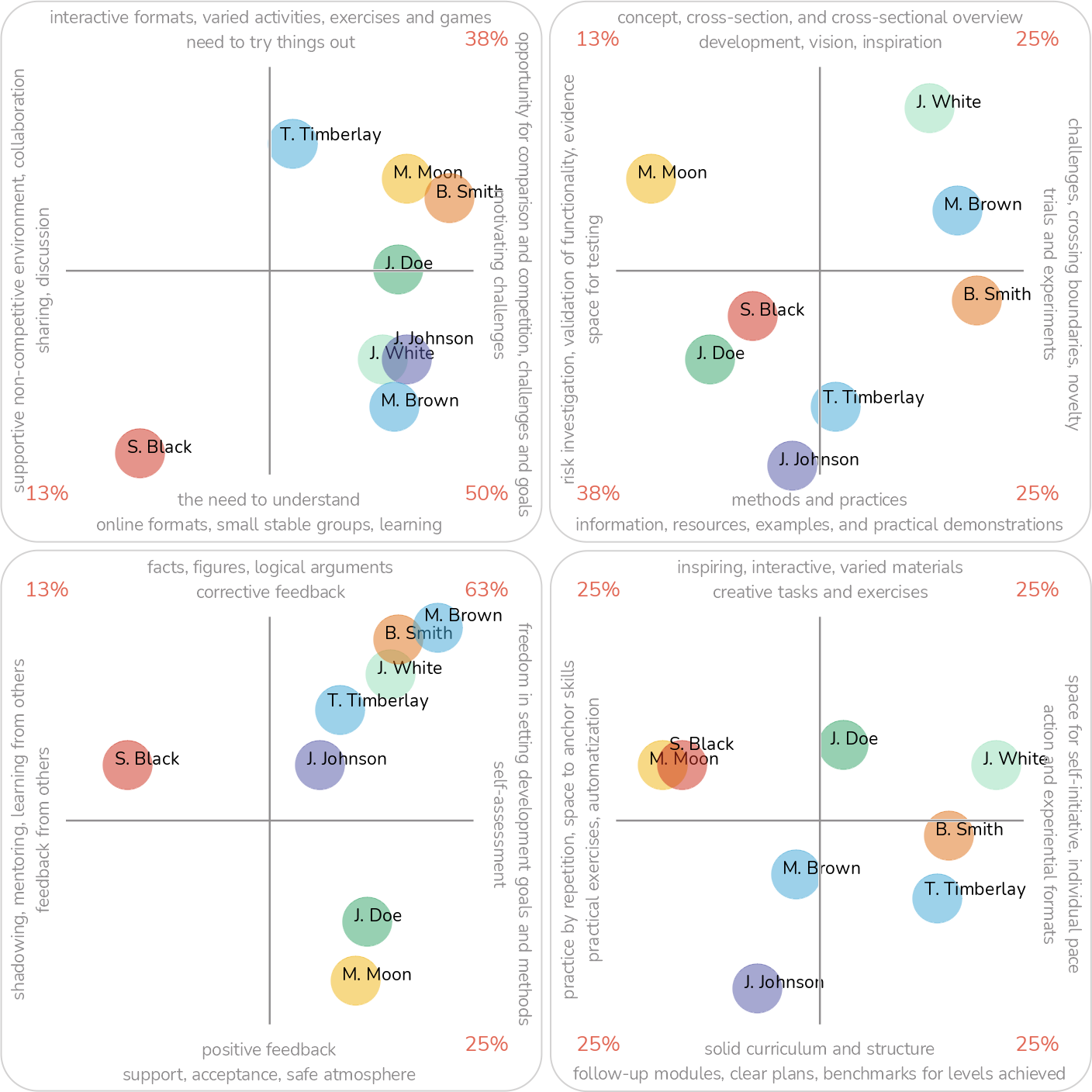
Psychodiagnostics – Mapping Team Development Activities, sample from a TCC online output report
360° Feedback: A Multi-Angle Mirror
While psychodiagnostics looks inward, 360° feedback is the ultimate tool for understanding how a person is perceived by those around them. While it isn’t entirely objective—since it reflects the unique biases and personalities of the reviewers—it is highly grounded in workplace reality.
Psychodiagnostics might show that someone has great potential for structure, but only 360° feedback reveals how they apply that potential in real life. Through it, a manager might discover that their meetings actually feel disorganized and inefficient to their team.
Additionally, 360° feedback offers team-level reports that highlight shared strengths and development opportunities, showing just how aligned or diverse the group really is.
For a leadership team with similar skill levels and shared development areas, it makes sense to design a joint program around feedback and psychological safety. This builds a peer community where they can share experiences and grow together.
On the other hand, if two senior team members score significantly higher than the rest, it’s much better to leverage them as mentors for junior colleagues while focusing their own development on advanced leadership competencies.
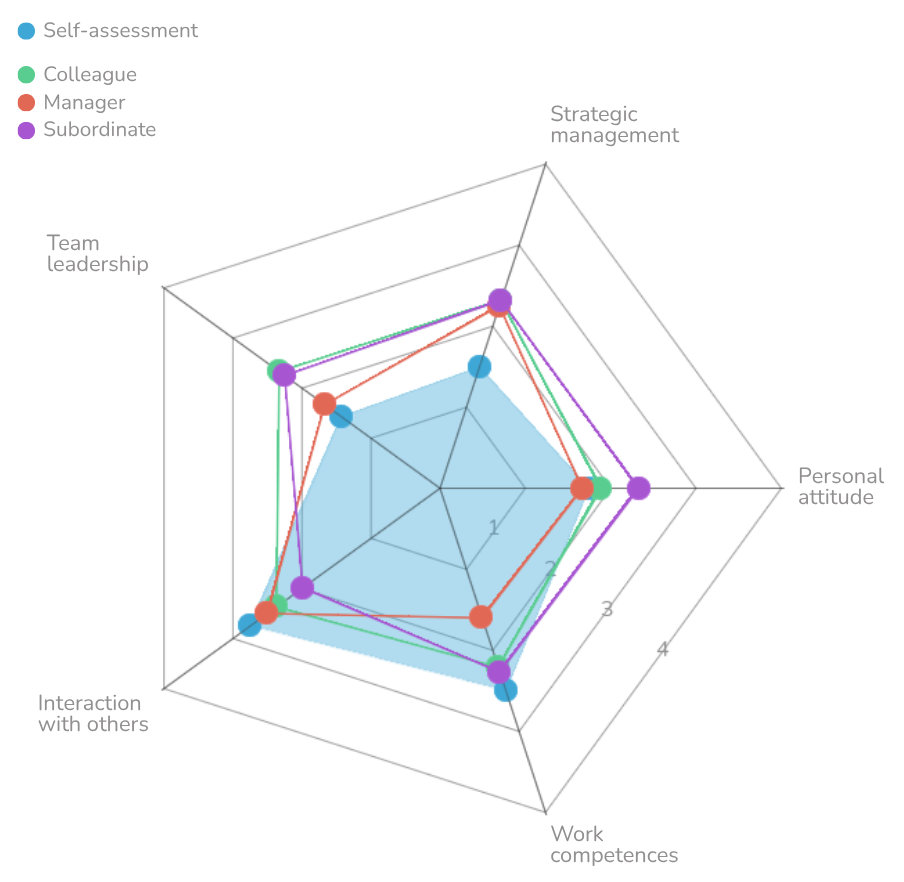
360° Feedback – Ratings by Individual Rater Groups, sample from a TCC online output report.
Psychodiagnostics Revisited: How to Approach Development
Combining these tools tells us what to develop. But psychodiagnostics adds another crucial dimension: it reveals how to do it by showing which learning format suits each individual best.
These insights also help the facilitators themselves, allowing them to adapt to the group’s dynamics and tailor the program to the participants’ specific needs.
A Guide Brings the Map to Life
You now have the data and insights showing where to focus your energy. However, it is always worth involving an experienced guide—whether a manager, consultant, coach, or mentor—whom you trust to interpret the results.
Taking the time to slow down, reflect, and walk through personalized recommendations can make the difference between letting a great development map gather dust and actually taking the first step forward.
How Can You Get the Most out of Your Data?
A common question is: When should we use psychodiagnostics or 360° feedback, and how often should we repeat them?
The right time is always at the very beginning—when planning development, setting goals, or designing training programs.
Re-evaluating to measure progress only makes sense once enough time has passed for real change to take root. You also have to give the people around them time to actually notice that change. If someone has earned a reputation as the “chaotic latecomer,” their coworkers will need to see consistent punctuality before they believe it’s not just a fluke. That’s why we recommend repeating 360° feedback every six to twelve months. Since psychodiagnostics measures more stable personality traits, re-testing is usually only necessary when someone transitions into a completely new role.
So, if you’ve used 360° feedback or psychodiagnostics individually but have never combined them, give it a shot. You’ll see the difference it makes.
Author: Marta Fabiánová
Source: Firemní vzdělávání 6/2026