



Author: Ivana Vasilis, Business Development & Sales Operations Manager
This is an English translation of an article originally published in HR News.
The pressure to be agile, adaptable, and continuously acquire new skills is an everyday reality in today’s corporate environment. Yet the same mistake keeps recurring when development programs are planned: development is designed without a precise understanding of the starting point. Ivana Vasilis shows how to set up the development process correctly from the very beginning so that it is targeted, measurable, and ensures that the investment does not go to waste.

Carl Gustav Jung pointed out that until we make unconscious processes conscious, they will continue to shape the course of our lives. This idea applies just as well in the context of managerial development. Any effective development requires deep self-knowledge. If managers do not understand their natural limits and talents, they develop blindly. Self-reflection alone is not enough to achieve an objective perspective. The ideal solution is to combine two different yet mutually complementary tools.
What Will You Take Away From This Article?
- A use case will show how the identification of managers’ development areas works in practice, helping L&D specialists target what truly matters right from the start.
- Psychodiagnostics identifies development areas and also reveals whether development will require enormous effort from the manager or, on the contrary, whether it will come naturally.
- 360° feedback holds up a mirror to managers, uncovers blind spots, and shows the real impact of their behavior on the team.
Psychodiagnostics and 360° Feedback
Psychodiagnostics provides information about a manager’s personality, work motivation, values, and preferred corporate culture. 360° feedback offers a structured view from real colleagues on a person’s behavior and complements it with self-perception, i.e. self-assessment.
The main differences can be summarised as follows:
| Psychodiagnostics | 360° feedback |
| Measures hidden potential and innate talents. It compares results with the broader working population, providing objective benchmarks. | Evaluates real behavior and its impact on the team. It reflects the subjective opinions of evaluators, naturally influenced by the company culture. |
| Is entirely independent of how likeable others find the person. It uncovers internal motivators and personality strengths. | Reveals differences between self-assessment and the assessments of others: “how I see myself vs. how others see me.” |
| Offers development topics suited to the individual’s personality. It shows in which areas development will be fastest and most effective based on the person’s natural disposition. | Highlights differences in perception among various groups, such as colleagues and direct reports, and provides tips for development in specific situations. |
Thanks to both psychodiagnostics and 360° feedback, managers gain clear inspiration on what to work on, what to change, and which behaviors to develop or abandon. Psychodiagnostics also reveals whether, given their personal predispositions, this development will come easily or whether it will be hard work.
Managerial Development: How Do the Best Get Started?
At the beginning, the typical choice is a combination of psychodiagnostics and 360° feedback. Among psychodiagnostic methods, for example, the Multifactor Personality Profile can be used together with the Managerial Style questionnaire. The outputs then show the difference between a managerial style based on personality—that is, what is natural for the manager—and the styles the manager actually uses.
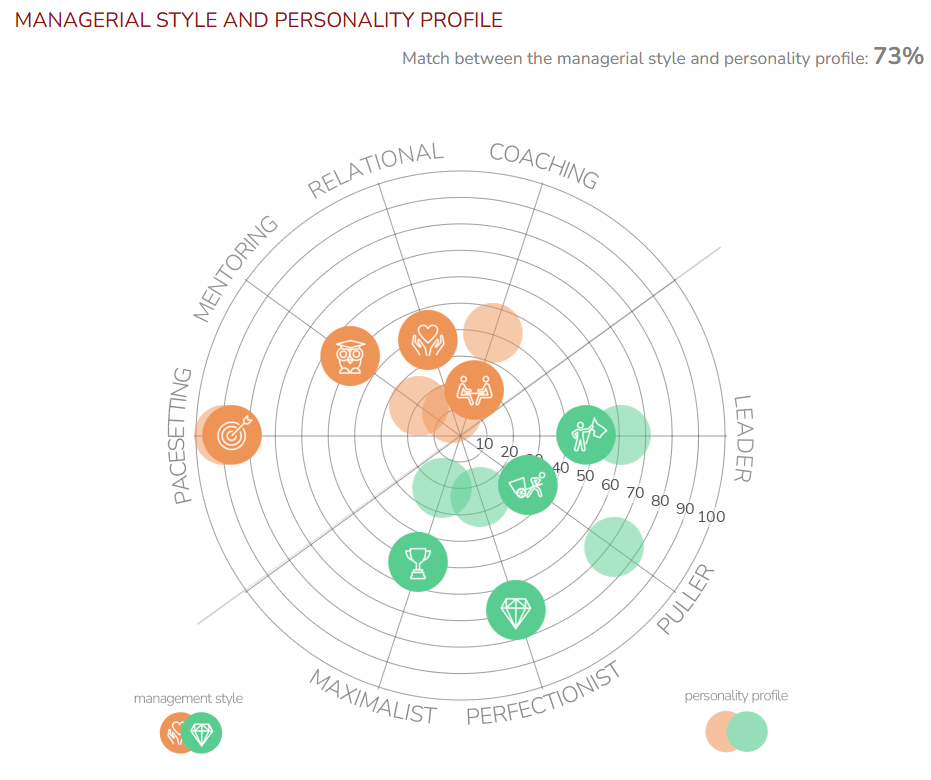
Chart: Alignment between managerial style and personality profile—sample from the output report of the Managerial Style questionnaire, TCC online
The manager in the example currently prefers the “ pacesetting perfectionist” style. He is precise, sets rules consistently, and expects them to be followed, which becomes limiting when he needs to develop his team. While he has strong personality predispositions for being performance-oriented, the role of “perfectionist” is not particularly natural to him. He may have arrived at this style due to circumstances, for example, by leading a junior team that required firm structure and control, or by making a conscious choice based on the needs of the team or the expectations of senior management.
His natural disposition is that of a “driver”: a manager who sets direction and motivates people towards results by leading through example rather than through control.
This is where the strength of psychodiagnostic tools becomes clear: they can go beneath the surface and reveal what is not visible at first glance.
- The effective path: Development towards the “driver” style will be fast because it builds on his natural talent.
- The energy trap: The data warns against micromanagement, which is typical of “perfectionists.” Detailed task assignment and strict control are not natural for this manager, yet he currently uses them to a considerable extent. This may cost him a great deal of effort.

Chart: Situational leadership – sample from the output report of the Managerial Style questionnaire, TCC online
The preferred managerial style is highly effective when leading junior employees who need clearly defined procedures and stronger external motivation. However, the situation is entirely different with independent, senior team members. For them, this style may be counterproductive and may dampen their enthusiasm.
If psychodiagnostic questionnaires are supplemented with 360° feedback, additional development opportunities emerge.
In the “team leadership” competency, direct reports, colleagues, and the line manager assess behaviors such as:
- Assigns tasks to others clearly, unambiguously, and understandably.
- Emphasises the best possible performance from people in their team.
- Entrusts team members with responsibility for tasks and gives them space to work independently.
- Can recognise the strengths and weaknesses of direct reports and supports their development.
A manager with a “pacesetting perfectionist” profile will probably see positive ratings for the first two items in the report. However, the results for the remaining two items will likely reveal that direct reports lack space for independent work and support for their development.
The greatest trap is thinking that a manager must be perfect at everything. If 360° feedback shows that the team needs development and coaching, while psychodiagnostics reveals that the manager does not have the necessary natural predispositions for it, the solution does not necessarily have to be remaking the manager from the ground up. The solution is to use their strengths—for example, by turning development into a structured process. What matters most is whether the manager personally has the will to grow. The role of L&D is then to create the right conditions for that growth.
What Matters Most When Combining Psychodiagnostic Methods and 360° Feedback?
To gain the greatest benefit, focus on these three things:
1. The difference between how managers perceive themselves and how they are perceived by other groups of evaluators, especially direct reports.
These differences, along with information about how important individual competency behaviors are to evaluators, provide the clearest picture of where the manager needs to develop.
2. The energy demands of change.
Monitor whether the manager is trying to develop in an area that goes sharply against their natural disposition. If so, look for ways to address the requirement differently, for example, through delegation or a change in process.
3. Trends and progress over time.
Psychodiagnostics is essential at the beginning of development. It makes sense to repeat it only after a longer period of time, for example, after the manager has gained new experience or changed roles. It is equally important to monitor the development of competency behaviors in practice. For this reason, it is recommended to repeat 360° feedback after some time, for example, after one year.
How to Work with These Tools in the Long Term
Both psychodiagnostics and 360° feedback are excellent tools with strong standalone value. However, only by combining them do L&D and HR managers gain a complete picture of managerial functioning—and, above all, the confidence that time and energy are not being invested in development that goes sharply against the manager’s natural personality.
This combination is particularly effective at the beginning of development programmes. It helps identify development topics both at the individual level and at the level of the entire team or managerial group. The results also serve as a strong argument for senior leadership. They provide concrete data on where development makes the most sense and where there is a risk of wasting energy and financial resources.
Take the First Step Towards Conscious Leadership
L&D specialists and HR managers have the tools to support managers effectively on this journey.
Map their true potential, find out how they are actually perceived by those around them, and focus development investments where they make the most sense. If you help your managers bring unconscious processes into consciousness, they will stop developing blindly. Instead, they will gain clear data about who they are and how they affect others—a key prerequisite for genuine, self-aware leadership.
Turn Insight into Targeted Development
At TCC online, we provide both psychodiagnostic tools and 360° feedback solutions to help organisations develop managers with greater clarity, focus, and impact. To find out how we can support your leadership development, contact us at info@tcconline.eu.